
Introduction: Why Knowing When to Call 999 in the UK Matters?
If you’re new to the UK, understanding how to use the NHS properly is really important، especially if you’re not yet familiar with the system. Going to the wrong service (like heading to A&E for something like an eye infection or a long term ache) can create longer waits for people who need urgent care the most.
That’s why this guide walks you through exactly when to call 999 (for life threatening emergencies) when to call 111 (for urgent but non emergency advice) and when to see your GP. For a broader overview of settling in and managing everyday life here, check out our Complete Beginner’s Guide to Life in the UK. it covers health, housing, finances and more to help you get started smoothly.
This quick guide helps you protect the NHS while getting the right help fast and easily.
Part 1: The Three Main NHS Services
The NHS has three main ways to get medical help. You need to know the difference between them:
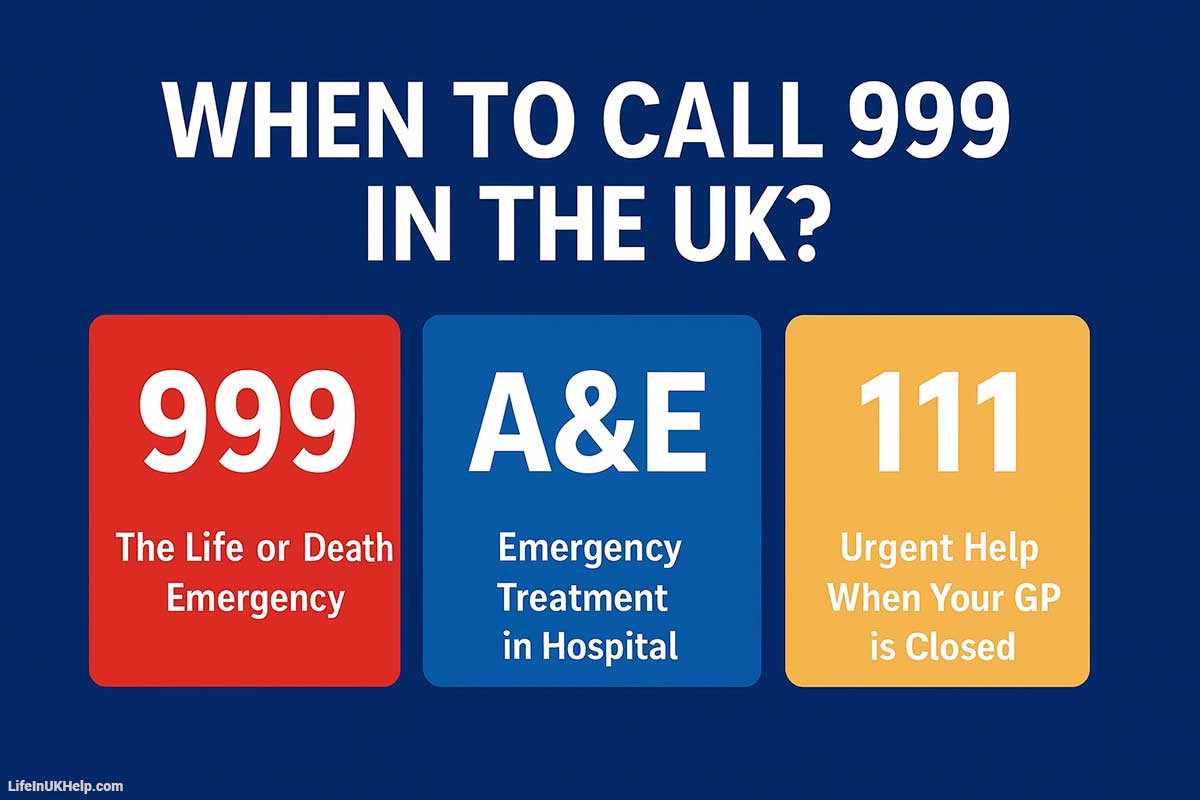
999: The Life or Death Emergency
- This is the number you call for an ambulance, the police, or the fire service.
- Goal: To save a life or a limb.
- Response: Very fast, but only for the most serious problems.
A&E: Emergency Treatment in Hospital
- A&E stands for Accident & Emergency. It is often called “The Emergency Department.”
- Goal: To treat serious injuries or sudden, severe illness that must be looked at immediately.
- Important Note: A&E does not treat minor issues, long term pain, or common illnesses like the flu.
111: Urgent Help When Your GP is Closed
- 111 is the NHS non emergency number.
- Goal: To get fast medical advice and direction when your problem is urgent but NOT life threatening.
- Response: Trained advisors and nurses help you decide the best service (GP, pharmacy, or A&E). They can also book you an appointment at an Urgent Treatment Centre (UTC).
Did you know?
Did you know that calling 111 can book you a same day appointment at an Urgent Treatment Centre or out of hours GP? Many people go straight to A&E without knowing that 111 can book appointments for you, saving hours of waiting.
Part 2: When to Call in the 999 in the UK / The Emergency Checklist
You should only call 999 if the situation is a medical emergency where someone’s life is in danger. Do not call 999 for a minor illness or injury.
You must call 999 immediately if you see these medical emergency signs UK:
- Loss of consciousness: The person cannot wake up or respond to you.
- Severe breathing difficulties: The person is choking, struggling to breathe, or has stopped breathing.
- Severe chest pain: This could be a heart attack. The pain is sudden, crushing, and may spread to the arms, neck, or jaw.
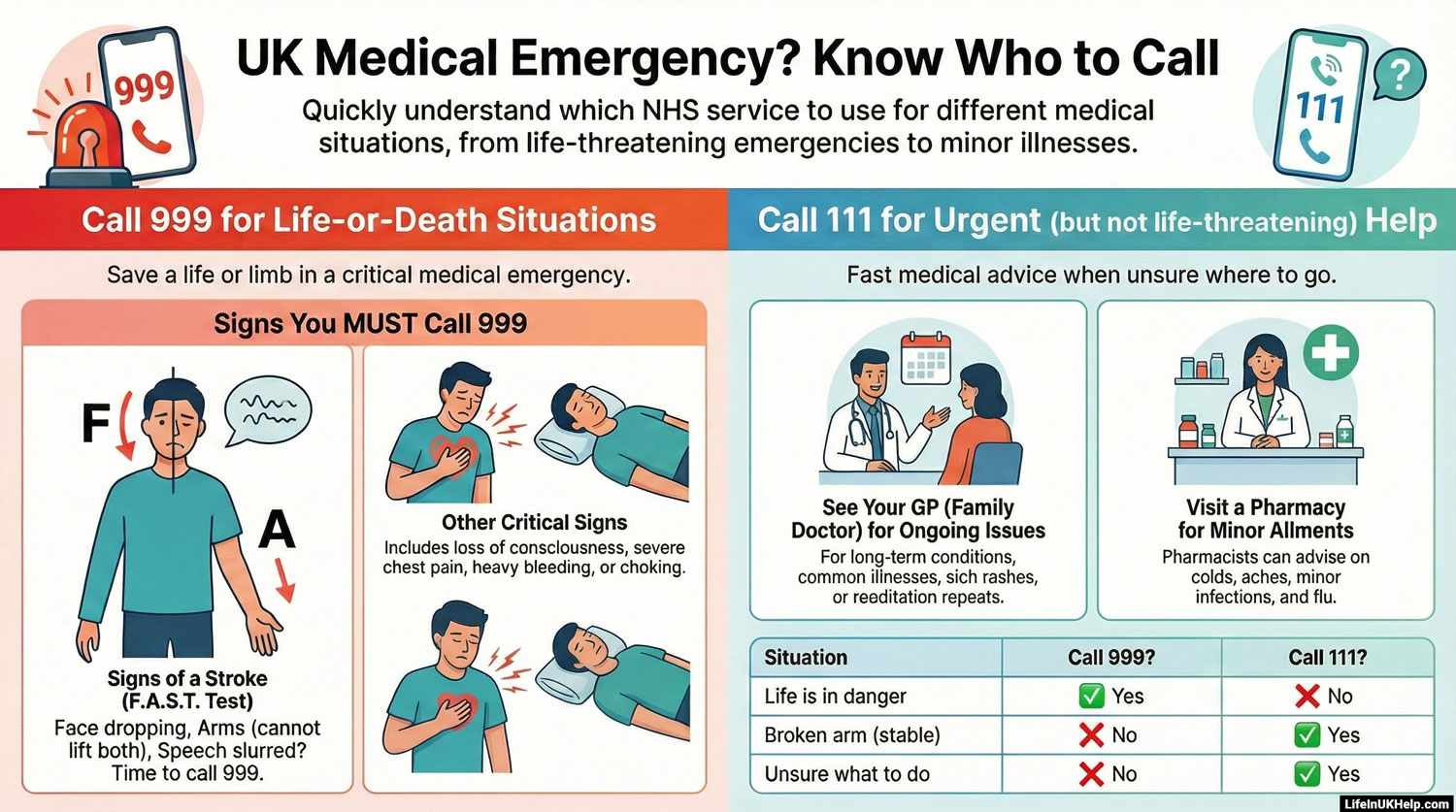
- Signs of a Stroke: Use the FAST test:
- Face: Is one side of the face dropping?
- Arms: Can they lift both arms?
- Speech: Is their speech slurred or difficult?
- Time: If you see any of these signs, call 999 immediately.
- Heavy bleeding: Bleeding that will not stop, or a major, deep wound.
- Severe burn or scald: The burn is large or deep, or on the face or genitals.
- Severe allergic reaction (Anaphylaxis): Swelling of the face, tongue, or throat.
- Fit or seizure: A fit that is happening for the first time or is lasting for a very long time.
What to Say When You Call 999
- Stay calm and speak clearly.
- Say clearly which service you need first (Ambulance, Police, or Fire). Say “Ambulance.”
- Give the exact address, postcode, and landmark (e.g. The house next to the large red telephone box).
- Explain what happened in short, simple sentences.
- Stay on the line! The operator will give you important instructions on how to help the person until the ambulance arrives.
Part 3: When to Call 111 and the 999 vs 111 UK Difference
If your problem is urgent but not life threatening, you should call 111 or visit the NHS 111 online service. This is the correct choice for non life threatening medical help UK.
The advisor at 111 will ask you questions about your symptoms. They will then tell you what to do next.
999 vs 111 – Quick Comparison
| Situation | Call 999 | Call 111 |
|---|---|---|
| Life in danger | ✅ Yes | ❌ No |
| Severe chest pain | ✅ Yes | ❌ No |
| Broken arm (stable) | ❌ No | ✅ Yes |
| High fever | ❌ No | ✅ Yes |
| Not sure what to do | ❌ No | ✅ Yes |
You Should Call 111 When:
- You need urgent medical advice, but it is not a 999 emergency.
- You think you need to go to A&E or an Urgent Treatment Centre, but you are not sure.
- You need health information or advice.
- You need to see a doctor or nurse outside of your GP’s normal opening hours.
- You do not know where to go for help.
Part 4: When to go to A&E UK and Avoiding Misusing A&E UK
A&E is for the most serious illnesses and injuries. It is not a place for convenience. When you misuse A&E, you cause serious problems for the NHS staff and other patients.
Why People Misuse A&E (And Why They Shouldn’t)
- They think it is faster than the GP. In A&E, patients are seen by clinical need, not arrival order. A person with a severe cut will wait hours, while a person with chest pain is seen immediately. You may wait for many hours for a minor issue.
- They want a specialist test (like an MRI). A&E will do tests to check if you are dying, but they will not manage your long-term condition. They will send you back to your GP for a long-term care plan.
- They are unhappy with their GP. If you are unhappy with your GP, you should follow the NHS complaints procedure or register with a new GP not use the emergency department.
Best Alternatives to A&E
For all non emergency health problems, you should choose one of these first:
- Your Local Pharmacy: Pharmacists are trained health professionals.They can give advice and medicine for many minor problems, such as colds, flu, aches, and minor infections. To find a pharmacy near you click Here.
- Your GP: Use your GP for long term pain, medication repeats, common colds, skin rashes, or mental health concerns.
- Urgent Treatment Centres (UTCs) or Walk in Centres: These centers treat less serious injuries like sprains, minor burns, or suspected simple broken bones. If you call 111, they can direct you to the best UTC.
Part 5: What If You Cannot Speak English?
If you are calling 999 or 111 and you do not speak English well, do not worry. The NHS has a free translation service for all emergency calls.
- Dial 999.
- When the operator answers, clearly say the word “Ambulance.”
- When the ambulance operator answers, calmly say “Interpreter please!” and then state the language you speak (like: “Polish interpreter please” or “Arabic interpreter please”).
- The operator will find an interpreter and connect them to the call. This takes a few moments.
- When the interpreter joins, you can explain the situation clearly in your own language.
- Stay calm and answer all questions from the operator and the interpreter.
This service is free and available 24 hours a day.
Click to enlarge
Part 6: Protecting the NHS / Your Responsibility
The NHS is a public service that belongs to everyone living in the UK. Using NHS emergency services UK correctly is a social responsibility.
When you use A&E or 999 for a minor problem, you cause two main things to happen:
- You use up resources (ambulances, staff time, hospital beds) that a person with a life-threatening problem urgently needs.
- You increase the waiting time, leading to abuse of staff and serious delays for others.
By choosing the GP, the pharmacy, or 111 for minor issues, you help keep the emergency services free for true emergencies.
Conclusion: Your Simple Action Plan
Remember this simple action plan next time you need medical help in the UK:
- Is this a life or death emergency? (Example: Chest pain, choking, severe bleeding, stroke signs). CALL 999.
- Is this urgent but not life threatening? (Example: Can’t wait for GP, unsure where to go). CALL 111.
- Is this a common illness or minor issue? (Example: Cold, flu, long term pain). SEE YOUR GP OR PHARMACIST.
Knowing when to call 999 in the UK and using NHS emergency services wisely is the best way to keep yourself and your community safe. For more advice on life in the UK, please check our other guides.
Have a question in mind?
Post it in the comments. I will reply and share the answer with everyone. For personal queries, please reach me via my Contact page.