
Moving into a new home in the UK is exciting, but it can also feel overwhelming, especially if you are new to how things work here. If you are still getting familiar with everyday UK systems, our guide Living in the UK for Beginners: A Clear Roadmap gives a simple overview of what to expect.
One of the first stressful moments for many tenants is paying a large deposit. By law, your landlord cannot simply keep this money in their personal bank account. They must register it with a specific scheme to keep it safe.
However, many tenants worry that their landlord might ignore the rules. If you are asking yourself “how to check if landlord protected deposit,” you are not alone. It is a very common concern for newcomers.
This guide is for anyone renting a home in England and Wales on an Assured Shorthold Tenancy (AST). We will show you exactly how to find out if your money is safe, using simple steps.
«Why People Search for This Topic»
When people search for this topic, they are usually worried about their money.
- They might think their landlord is dishonest or has forgotten the rules.
- They want to know if they will get their money back at the end of the tenancy.
- They need to know if they can claim compensation if the landlord broke the law.
The goal is to feel safe and ensure their rights as a tenant are respected.
Short and Clear Answer
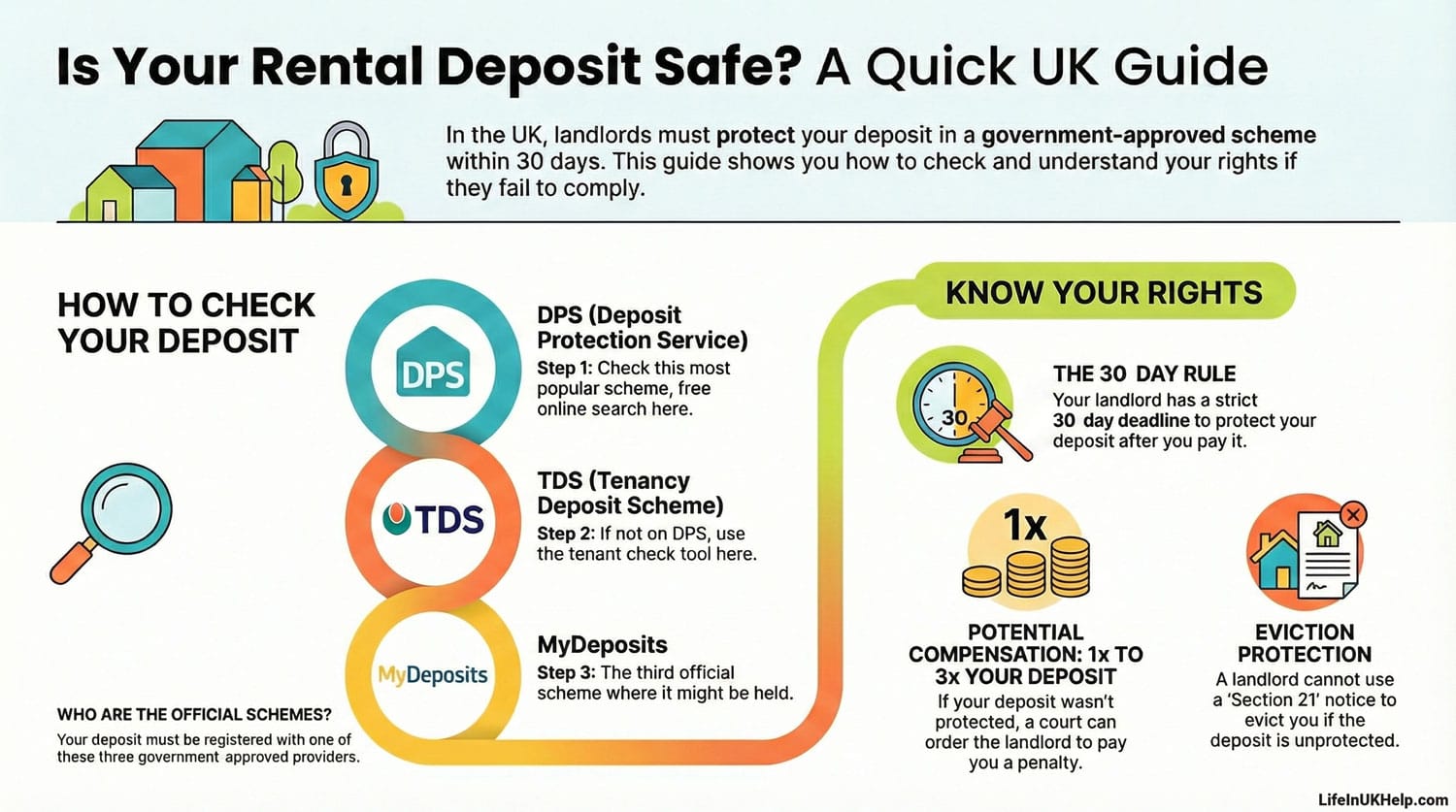
Yes, you can check online for free. There are only three government-approved providers in England and Wales. You do not need your landlord’s permission to check.
- Deposit Protection Service (DPS)
- Tenancy Deposit Scheme (TDS)
- MyDeposits
If your landlord has protected your deposit, your name and address will be listed on one of these three websites.
Rules are different in Scotland and Northern Ireland. (Click to enlarge)
Explanation
In the UK, if you rent a home on an Assured Shorthold Tenancy (the most common type of contract), your landlord legally must protect your deposit.
They must do this within 30 days of receiving the money from you.
“Protecting” the deposit means they send it to a third-party organisation (a scheme). This organisation holds the money or insures it. This stops the landlord from spending your money or refusing to return it unfairly when you move out.
If they fail to do this, they are breaking the law. This is very serious for them, but it can be good news for you, as you might be entitled to compensation.
Step by Step Guide: How to Find Your Deposit
You need to check all three schemes because your landlord could have used any of them. You will need your postcode, surname, and the date your tenancy started.
| What You Need to Check | Website | Scheme Name |
|---|---|---|
| Tenancy Start Date + Postcode | depositprotection.com | DPS (Deposit Protection Service) |
| Surname + Tenancy Code (or Property details) | tenancydepositscheme.com | TDS (Tenancy Deposit Scheme) |
| Postcode + Month you moved in | mydeposits.co.uk | MyDeposits |
Step 1:
Check the Deposit Protection Service (DPS) website.
Go to the DPS website and look for the “Is my deposit protected?” section. Enter your tenancy details. This is the most popular scheme.
Step 2:
Check the Tenancy Deposit Scheme (TDS) website.
If you didn’t find it on DPS, go to the TDS website. They have a tenant check tool. Try searching with your surname and tenancy code if you have it, or just the property details.
Step 3:
Check the MyDeposits website.
Finally, check the MyDeposits tenant checker. If it is not on the first two, it might be here.
Step 4:
Check your email inbox.
Search your email for “Prescribed Information” or “Deposit Certificate.” The scheme usually sends you a confirmation email when the landlord registers the money. Check your Spam or Junk folder too.
Simple Example
Imagine Sam moves into a flat in Manchester on January 1st. He pays a £1,000 deposit. By January 31st (30 days later) his landlord must protect that money.
In February, Sam hasn’t heard anything. He goes to the DPS website and types in his postcode and the date he moved in. The website says “Deposit Found.” This means his money is safe. Sam can relax knowing the landlord followed the rules.
Important Things to Know
There are some strict rules about deposit protection that you should remember:
- The 30 Day Rule: The landlord strictly has 30 days from the moment they receive your cash or transfer to protect it.
- Prescribed Information: The landlord must also give you a document called “Prescribed Information.” This tells you where the money is and how to get it back.
- Compensation: If the landlord did NOT protect your deposit within 30 days, you can take them to court. The court can order them to pay you between 1 to 3 times the amount of the deposit as a penalty.
- Eviction Protection: A landlord cannot legally evict you using a “Section 21” notice if they have not protected your deposit correctly.
Tips and Warnings
- Tip: If you live with other people, try searching using the “Lead Tenant’s” name (the person who signed the contract first or dealt with the agent).
- Warning: Do not wait until you are moving out to check this. Check it a few weeks after you move in. It gives you power if there are disputes later.
- Common Mistake: Entering the tenancy start date incorrectly. Use the exact date written on your contract.
Official Information Source
For legal details, always check the government guide: Official guidance on GOV.UK about Tenancy Deposit Protection
Frequently Asked Questions
1. How can I check if my landlord protected my deposit in the UK?
You can check for free by searching your details on the three government-approved deposit protection schemes: DPS, TDS, and MyDeposits. You do not need your landlord’s permission to do this.
2. How long does a landlord have to protect my deposit?
Your landlord must protect your deposit within 30 days of receiving the money. This applies to most private rentals under an Assured Shorthold Tenancy.
3. What if my landlord protected my deposit late?
If your landlord protected the deposit after the 30-day deadline, they may still be in breach of the law. In some cases, tenants can claim compensation, even if the deposit was protected later.
4. What information do I need to check my deposit online?
You usually need your postcode, surname, and the date your tenancy started. If you are a joint tenant, try using the lead tenant’s name.
5. Can my landlord evict me if my deposit was not protected?
In most cases, a landlord cannot legally use a Section 21 eviction notice if the deposit was not protected correctly or if prescribed information was not provided.
Conclusion
Checking if your landlord protected your deposit is quick, free, and gives you peace of mind. It is your legal right to know your money is safe.
If you check all three websites and find nothing, ask your landlord politely first. If they still don’t provide proof, you have strong legal rights to protect yourself. Don’t worry, the law is on your side.
Related Articles on Life in UK Help
- Signing a Tenancy Agreement? 5 Checks to Make
- How to Register with a GP in UK: 5 Easy Steps
- Council Tax Discounts: 5 Simple Ways to Pay Less
Have a question in mind?
Post it in the comments. I will reply and share the answer with everyone. For personal queries, please reach me via my Contact page.
Hi,What should I do if I can’t find my deposit on any deposit scheme?
Hi my friend
First send a short and polite email to your landlord or letting agent and ask for proof. You can say that by law the deposit must be protected in a government approved scheme within 30 days and ask them to reply in writing within. for example 7 days with the name of the scheme, the date it was protected and the deposit certificate.
Keep this email safe.If you need to make a complaint or take legal action later. it shows that you tried to resolve the issue in a reasonable and professional way.
Good luck